Showing posts with label Amazon Vine. Show all posts

Better living through skyjacking

SkiesBelongA book that opens with dueling quotes from Virgil and Ghostface Killah is bound to have an expansive point of view. The Skies Belong to Us does not disappoint. Part history of The Golden Age of Hijacking (author Brendan Koerner’s term) and part story of two unlikely hijackers, all informative entertainment.

Koerner’s shows the evolution of hijacking in the United States during the 1960s from the use of threats and deception to secure a means of transport to Cuba to the use of threats and deception to secure unwieldy amounts of cash to the 1970s innovation of using threats and deception to secure unwieldy amounts of cash and transportation to Algeria. Occasionally someone will use a hijacking as a form of protest but aside from the rare instance of a mentally ill person acting out of delusion it’s all cash or Cuba.

The airlines priorities are clear: aircraft, passengers and future revenue. It’s not that the airlines would risk passenger safety to protect a 707, they’re just convinced that main concern of hijackers is, to quote Tattoo, de plane, de plane. Airlines see passenger priorities as convenience first, safety second. In their eyes, given a choice between having their carry on bags x-rayed and an unscheduled trip to Havana, passengers would rather have their inconvenience be of the unexpected nature. Koerner depicts the power struggles between the airlines and the FBI and the White House over how to stop the hijacking epidemic as reminiscent of a parent trying to get a teenager to clean his room: lots of excuses, promises and reasons why it just cannot be done.

The French government and for a surprisingly long time even the American people viewed hijacking as a form of social protest slightly more annoying than a sit-in. Only Fidel Castro, tired of having hijacked planes show up on short notice and suspicious of the hijackers, takes umbrage over the trend, setting up a “Hijacker House” to accommodate the determined tourists.

The other half of the book, that of would-be hijacking masterminds Roger Holder and Cathy Kerkow is by turns jaw-dropping, hilarious and pathetic. Holder was charismatic and damaged, Kerkow was a happy-go-lucky survivor. Together they did not make a dynamic duo yet they managed to succeed where so many others had failed. Unfortunately for them, that is their only success. Holder and Kerkow weren’t brimming with possibility before the hijacking. Holder’s father wearily admits to the press that the hijacking “sounds like something our crazy son would do” while Kerkow’s co-workers express surprise that “she could follow orders well enough to be a hijacker.” After the hijacking they were sentenced to a weird international limbo that leaves them at the mercy of the Algerian and French governments and the whims of Eldridge Cleaver. From one form of powerlessness to another.

For me, the sections about Black Panther Eldridge Cleaver alone make this book essential reading. Whether he’s complaining about the high cost of international telephone calls, taking up cooking (“I like the rational, systematic way that the Chinese move on cooking. And the results are so rewarding”) or entering the cut-throat world of high fashion by reintroducing the codpiece (“They’re all accentuating your boo-boo …That’s what I’m trying to get away from,”) Cleaver provides mind-bending entertainment.

The story, pacing and structure of the book (short chapters that alternate the two storylines) make this a perfect summer read. Highly recommended for any non-fiction reader.

Spade work

The Janus Stone starts with leisurely pace. Bones are found. Forensic archaeologist Ruth Galloway is called. And then ... we spend several chapters pondering the back story of Galloway, her relationship with Harry Nelson, her relationship with her spiritually-certain parents, and revisiting the events of the first entry in this series. Once the focus returns to the mystery, and that is why readers like me picked up this book in the first place, the pace picks up slightly.
With archaeology-based mysteries the first questions are often who died and when. Once that's sorted out the story moves on to a more traditional whodunit. This one isn't going to break new ground in the genre. Ruth Galloway is reasonably interesting but not fascinating. The cast of supporting characters are nicely drawn but none is outstanding. The old "someone is trying to keep the murder a secret by killing the investigator" cliche is trotted out, which left me wondering as it always does why the murderer thinks that will work. The culprit is unmasked and situations are set up for the next installment.

The Janus Stone does show the full effects of being the second in series. Where the first entry can suffer from the author trying to introduce too many characters and back story in too much detail, a second entry can suffer from too much linking to the previous book. In the hands of a master, like Louise Penny, it can inspire the reader to seek out the earlier books but still enjoy the present book on its own merits. Griffiths is a good writer but her links to Crossing Places were less intriguing hints and more, hey, you're reading this out of order. I haven't read the first book but my advice is to start there and avoid the residual guilt.

This is a slightly frustrating book. The writing and characterizations are good but it is too conscious of being an entry in a series. The narrative trudges along like, well, an archaeologist in well-worn wellingtons but it is written in present tense which struck me as at odds with the slow pace. I'm not a fan of present tense narratives - it is rarely warranted and even less rarely works. It's not a showstopper here but it doesn't add anything.

Overall, if you like mysteries of the Bones variety you'll probably enjoy this book. Recommended for mystery fans.

Blonde, Brunette or Beheaded


How did a woman rise from relative obscurity to influence the course of history and become queen of England? That is the question nearly every biography and fictional account of Anne Boleyn seeks to answer. In The Creation of Anne Boleyn Susan Bordo seeks to answer that and a less explored question: how did Anne go from historical figure to cultural touchstone?

Bordo is a cultural studies specialist rather than a historian. She is primarily interested in what Anne Boleyn means to contemporary culture but she grounds that meaning in an understanding of who Anne was. Or, perhaps better put, might have been. Given the paucity of contemporaneous first-hand accounts it is impossible to know what Anne thought or what drove her actions or what was actually said or even whether she was blonde or brunette. This incomplete picture has left room for writers and artists of all types to create Anne as they see her or need her to be to suit their narrative or world view. Bordo explores these shifting images of Anne - the shadows of the real woman, alternately larger and smaller than the long dead queen - to understand what informed and drove these depictions.

For anyone immersed in Tudoriana, this book may feel quirky in its focus: an entire chapter the 1969 movie Anne of a Thousand Days yet nothing on Evelyn Anthony's or Lozania Prole's vastly different conceptions of Anne. The same is true of Boleyn biographies where Joanna Denny's unique take is unexplored. Bordo does not pretend that this is a definitive study of every depiction of Anne Boleyn. You may find your favorites left out but you will find detailed consideration given to The Other Boleyn Girl (book, miniseries and movie) and The Tudors, among others.

I enjoyed this book overall. I found Bordo's historical analysis less compelling (but still interesting) than her cultural analysis. When Bordo brings the two together, such when she reminds readers that we must read Henry's letters to Anne's through the lens of Courtly Love instead of Showtime, this book becomes essential reading. If you know Anne Boleyn only from recent movies and miniseries, this book is a good place to start to learn more about this fascinating woman.

From the Vine

Latest picks from Amazon Vine:


The Malice of Fortune by Michael Ennis


A mystery set in the time of the Borgias: "Niccolò Machiavelli and Leonardo da Vinci come together to unmask an enigmatic serial killer."

I'm pretty sure this is the episode that inspired Machiavelli to coin the phrase: Let the good times roll. That Leonardo, he really knew how to be in the right place at the right time.


My Samsung Galaxy Tab By Eric Butow, Lonzell Watson  


Yes, the book on how to use it is bigger than the tablet itself. Maybe that's a good thing - it's SO powerful and versatile it takes an encyclopedia! I've had my Galaxy for a year but there are still things that I'm probably doing the hard way. 


The Redgraves: A Family Epic by Donald Spoto


I foresee "The Redgraves: The Movie" in the offing. No matter. Donald Spoto is the one that claims Laurence Olivier had an affair with Danny Kaye so the gossip should flow like water. Preferably including juicy tidbits about Timothy Dalton and the family's reaction to Lynn's portrayal of The Happy Hooker. 


I Say, Would You Shut Up Already?

One of the enjoyments of a mystery series is meeting familiar characters. Sometimes they evolve over time, sometimes its all about how they don't change. Jill Paton Walsh stays very close to the spirit and the form of the Dorothy L. Sayers characters in The Attenbury Emeralds. Perhaps too close.

I read Dorothy Sayers' Lord Peter Wimsey series when I was a teenager enthralled by Golden Age mysteries. Sayers' mysteries were always less whodunit than howdunit. How did the one of the small group of suspects (the guilty one being easy enough to guess for any self-respecting mystery fan) manage to commit the crime? Another notable aspect of the series was the reliance on dialogue. The books read more like plays with very little non-spoken exposition which means that characters have to deliver often tremendous amounts of background information in the guise of witty repartee. It can get on your nerves.

What can really get on your nerves is Lord Peter himself. If you didn't like the original series you won't like this book. Sure Lord Peter is married with children now but that's never been a very convincing arrangement. Anyone who read the first Wimsey books would be forgiven for assuming that the monocled son of a duke was Out, Loud and Proud. (He still seems better paired with the loyal Bunter but I guess Harriet is a bit masculine so I'll play along.) Walsh tries to update the series by referencing the changes in society - they don't eat in the formal dining room now! - which is fine in small doses.

But she takes is too far. How far? Somewhere around page 80 Walsh blithely mentions that sometimes Bunter the butler and wife sometimes sit down to dinner with the Wimsey family. I'd sooner believe that Harriet and Peter were committed Maoists.

The story is a bit blah. Starting out by having Peter recount his famous first case might not be a bad idea but its told in dialogue form with Harriet making witty comments and Bunter chiming in lugubriously to add an important detail and Peter losing the thread in his usual slapdash way.

It made me want to smack them. Yack, yack, yack. By page 40 I was praying for a murder. By page 50 I was willing to settle for the delayed detonation of a World War 2 bomb somehow left unnoticed in the Wimsey living room. Instead they went for a stroll to look at flowers while Peter kept telling the story and no one emerged to drown them in the Serpentine. There is eventually a murder which let's Peter and Harriet do their stuff: solve the murder while bouncing bon mots back and forth. The Wimsey family encounters a few significant developments, too, which does surprisingly little to dampen the witty repartee.

In summary, I didn't enjoy this book. Walsh is a talented writer but Lord Peter is best left in the inter-war years where class consciousness explains why no one throttles him and everyone can pretend that he isn't as gay as a spring day. If you're a huge fan of the Wimsey series this book might be for you. If you've never read any of Sayers' books then read a sample chapter first. Without the back story this might be an enjoyable mystery.
When a novel promises to tell the story of a famous actress from Hollywood's golden age, potential readers might fear they are in Jackie Collins/Judith Krantz territory. Laura Lamont's Life in Pictures isn't a gossipy, trashy romp. It's a smart journey alongside a strong woman. One who on occasion is weak but who is never, ever less than real.

If you're a fan of big studio era Hollywood films, it's easy to start playing the who's who game. Is Irving Green a combination of David R. Selznick and Irving Thalberg? Is Laura Lamont really Jennifer Jones? Ginger must be Lucille Ball. Susie and Johnny? Hello Judy and Mickey. If none of the previous names mean anything to you, don't worry. You don't need to know anything about Hollywood to enjoy this book.

That's because the core of this book isn't about stardom, it's about happiness. Do we know what makes us happy? Or unhappy? It's also about what it means to be yourself. Early in the book the main character is rechristened in true Hollywood-style. Laura, formerly Elsa, remains the same person but understands that she now has two distinct histories and futures. There are simply things that Elsa could do that Laura can't or won't do. It's not a psychological split, it's acknowledgement of the bargain she's tacitly made.

This book deserves a wide audience. It is enjoyable and thoughtful without being maudlin or manipulative. Laura's life isn't perfect but her choices are believable and her strength a welcome change from the old "high price of fame" routine. Highly recommended for fans of Old Hollywood, movies and intelligent fiction.

(The perfect companion book to Laura Lamont is Jeanine Basinger's insightful The Star Machine which explains in entertaining detail how the great studios manufactured stars.)

Sundays with Louis

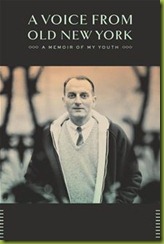
AuchinclossA Voice from Old New York is not an autobiography.It’s not exactly a memoir either, being generally low on gossip about the author or others.The chapters don’t quite flow into each other, instead each stands on its own. The book feels more like the reader is meeting Louis Auchincloss for coffee or drinks at a quiet hotel bar (upper East Side, please) and listening to him reminisce over over times.
Occasionally he repeats himself or lets drop tantalizing details without filling in the lines. At times you wish he’d dish the dirt a bit more or wonder at his rather set opinions but you can’t help admiring the clarity of his insight into the closed world he knew so intimately. There are not big revelations here. Auchincloss knew both the Bundy brothers (McGeorge and William) and the Dulles brothers (John Foster and Allen) but you’ll find nothing here you won’t find in their biographies. I did find yet another proof point for my personal theory that Nancy Mitford was born a bitter hag and got worse as she aged, not that I needed another.
If you want big statements on society (with and without a capital S), look to his novels and short stories. If you want to spend a few hours – this is a very short book at less then 210 pages – hearing the memories of the master chronicler of 20th Century New York Society.

Books I've Finally Managed to Finish

Some books just don't start well for me and it requires an effort to stick with them. Sometimes that effort is rewarded with a great story. Mansfield Park took 100 pages for me to really get into it. Even something as light and fluffy as Spying in High Heels didn't get going for 40 pages or so. I'll take slow start/great ending over great start/bad ending any day.

It doesn't always end well. Sometimes slow start ends in worse ending. Over the past months I've experienced the highs and lows of slow starts.

1. Caribou Island by David Vann   It took 3 false starts to finally finish this one. It never actually sailed along and it is as depressing as a 20 hour Alaskan mid-winter night but I respect it. Great writer. Maybe in need of Prozac or Lexapro; or just a few hours of Chappelle's Show.

2. Deadly Little Secret by Kathryn Casey   Spending over 50 pages with someone who is scared they are going to be murdered and who you know will be murdered is a little ghoulish. That made the first part of this book tougher going than is usual for Kathryn Casey. It definitely improves. This isn't her best but it's still worthy of any true crime fan's time.

3. Mansfield Park by Jane Austen  I've been on a classics kick lately and this is one of the books that's been sitting on my shelf, mocking me, for years. I finally tackled it last month and although it didn't grab me until the end of Volume 1, after that I couldn't put it down. According to the introduction in the edition I read this is Austen's "most complex and least likable novel." I can see why but it is definitely worth reading.

4. Oscar Wilde and the Dead Man's Smile by Gyles Brandreth  How do you make Oscar Wilde boring? If you're looking for lessons on that, and I can't imagine why anyone would, then seek out the first 50 or so pages of this book. Recounting famous incidents from Oscar's life isn't the best idea if you're going to make them dull. The mystery, once it gets going, isn't bad though perhaps needlessly complex and the evocations are 1890s decadence are a hoot.

I'm currently reading (listening to) Whose Body? by Dorothy L. Sayers and it suffers from another complaint: draggy middle section syndrome. The dialogue is snappy, although I don't see how Lord Peter Wimsey makes it through all those books without someone telling him to shut up and the narrator is making the most of it. But page after page about fingerprints - the lifting of them, leaving of them, photographing of them, measuring them, etc - is over the top, and not in a campy way.  Well, it's on the list so I'm going to finish it.

Must You Go On?

Must-You-GoIt's surprising that a dramatist known for his meaningful pauses inspired such a chatty memoir. Harold Pinter couldn't have asked for a more sympathetic biographer than his wife Antonia Fraser and this book, drawn from Fraser's journals, has a gentle intimacy reminiscent of a long, happy marriage.


Pinter emerges from these pages as a romantic (who knew?) devoted to his extended family. Fraser doesn't dish the dirt - even when it comes to their "scandalous" affair that broke up their respective marriages - nor does she present the couple as innocents. She does spend more time talking about the loss of beloved real estate than of discarded spouses but that is safer ground, I suppose.


I could have done with fewer pages about Harold's adventures with Vaclav Havel and other ventures into politics. Pinter's off-handed comment that Reagan and Gorbachev are "my boys" if their nuclear reduction treaty makes Fraser happy says far more about Pinter's devotion to his wife (and thus about him as a person) than a thousand rallies. But it is nice to learn that Pinter was a "house angel/street devil."

This isn't the definitive biography of Harold Pinter nor does it pretend to be. It is a warm remembrance of a man and a happy marriage.

Take that, Virgin Queen

Mary TudorPoor Mary Tudor. First she goes from being daddy’s little princess to nearly being daddy’s latest executed-loved-one. Then after surviving against all odds and every precedent to become England’s first queen regnant she keeps upstaged in death by her little sister Elizabeth and nicknamed “Bloody Mary” to boot. No doubt about it, sibling rivalry can be a bitch.

Anna Whitelock has written Mary Tudor: Princess, Bastard, Queen with the stated intention of reclaiming her rightful place in history for this perpetually beleaguered royal. She does this by creating a very accessible biography. The scholarship is evident but the writing style is surprisingly fast-paced. Tudorphiles won’t find much new in the two-thirds of the book. This is well-trodden ground and Whitelock focuses simply on Mary’s point of view without wringing out tenuous interpretations. She also shows Mary’s shift from obedient Catholic girl to a woman for whom faith offered the only constant in her life.

Once Mary becomes queen Whitelock takes great pains to demonstrate how she paved the way (definitely unknowingly) for little sis Elizabeth to become Gloriana. The idea of a woman as ruler was unthinkable prior to Mary. After Mary it was a viable option. Whitelock is less successful in redrawing the portrait of “Bloody Mary” although in fairness to the author that was probably not the intention. Instead of claiming Mary was in thrall to her advisors when she sent hundreds to be burned at the stake, Whitelock points out that Mary was perfectly willing to die for her religious beliefs and thus wasn’t too troubled by others dying for theirs. It’s not a sympathetic portrait but it strikes me as far worthier for this notable survivor.

Recommended for history readers and Tudorphiles.

Who’s Your Bootlegger?

Last CallLast Call: the rise and fall of Prohibition is a sometimes fascinating, usually interesting exploration of what in retrospect seems inexplicable. Daniel Okrent delves deep into the origins of the Prohibition to show its links to the Women’s Suffrage movement and latent xenophobia. He also shows the inner workings of Congress to explain how the necessary Constitutional Amendment was passed.

Okrent is at his best when his vignettes are grounded in a single person or event. For me he was at his worst when he would bring a character on stage, such as Wayne Wheeler, and wait hundreds of pages before telling us anything about the person other than his actions. When explaining a movement driven by deeply-felt and often deeply personal emotions keeping a distance doesn’t work.

What can’t be argued with is the vast amount of research Okrent clearly conducted, most of which seems to have found its way into the book. I had the odd sensation of wishing someone would quiz me on the Prohibition after finishing Last Call. It seemed pity to waste all that detailed knowledge. Which brings me to my major caveat for this book: it is not for the casual reader. If you want to learn about this important chapter in US history then you would be hard pressed to find a more comprehensive book. If, however, you are only mildly interested then this book is not likely to whip that mild interest into fascination. The mildly interested would be well-advised to skip judiciously – you don’t need to read all 480 pages to learn from and enjoy this book.

Okrent does have his focal points – Samuel Bronfman is one – and most fit well. His last discursion into whether or not Joseph P. Kennedy was or was not a bootlegger struck me as the oddest. Okrent’s contention that “most people” think JPK was a bootlegger seemed a little, how shall I say, a little 1975. I’m not sure most people even know who JPK WAS let alone what he was doing in the 1920s. If Okrent feels he’s cleared up a major misconception then bully for him but to me it was a missed opportunity to tie up the story.

Recommended for those interested in US history and highly recommended for anyone particularly interested in the topic.

Sympathy for the Devil

Fragile In the genre of women’s fiction, Jodi Picoult, Sue Miller and Anita Shreve exemplify the unwritten ground rules: an event of some trauma or import intrudes on the seemingly ordered life of a woman living in a seeming idyllic suburban or rural town. Lisa Unger certainly plays by the rules but she also manages to add her own stamp to the genre.

The plot description of Fragile may remind some of Rosellen Brown’s excellent Before and After but that’s merely superficial. Brown was focused on the toll taken on one family. Unger chronicles the impact on an entire town. Her cross-section of characters verges on over population at the beginning of the book but once the action kicks in the pattern Unger is weaving becomes clear. Unger is particularly good at showing the reader unpleasant characters without making them cartoonish. Even her most repellant characters retain a humanity.

There were a few things in Fragile that are, well, curious. One is Unger’s choice to saddle a major male character with the name “Jones”. At least it’s not “Storm”, I guess. Then Unger has one character named “Chuck”, another “Charlie” and a third “Charlene”. If she was trying to make the three a triptych of each other it doesn’t come off. Maybe she just likes the name Charles.

An enjoyable book. Recommended for fans of Jodi Picoult, Sue Miller and Rosellen Brown.

Sisterhood of Stupidity

bad boy In the realm of pop culture the female offspring with bad taste in men and a propensity for landing in life threatening-peril has a long history. Audra in The Big Valley, Diana Fairgate in Knots Landing, Kim Bauer in 24, to name but a few, inspired in viewers like me a weekly mixture of disappointment and awe. Disappointment that yet another perfectly good to kill them had been squandered and awe that any writer could think stupidity makes compelling entertainment. Into this rich tradition Peter Robinson’s Bad Boy launches DCI Banks’ daughter Tracey Banks, hitherto not renown for her imbecility.

Tracey, however, is a comer. And she’s surrounded by several idiotic characters and situations that serve to vault her own burgeoning dimwittedness into the stratosphere. In the first few chapters we are confronted with England’s dumbest mother – what do you do if you suspect your child is in trouble? Why you toddle down to the local police station; a “gun removal” procedure that despite several characters noting that it is “by the book” strikes me as being taking from the adventures of Larry, Moe and Curly; a cardboard cutout police villain; and Tracey, who has decided to call herself Francesca to spice up her boring life. Is it any wonder that Banks himself would choose to flee the jurisdiction and vacation in California? Sadly, he’s not in search of higher IQs, he’s off searching his soul after the collapse of his relationship with a younger woman and his encounter with MI5. He’s on a California whine tour.

To make matters even more entertaining, Robinson has decided to delete the mystery portion from this installment of this mystery series. You know who did it. Banks knows who did it. The only person who is momentarily dim on this is, you guessed it, Tracey. Her decision to cleave unto the bad boy of the title is one the goofier aspects of the book – he was her friend’s boyfriend, she just fancied him until the cops got involved. Then it’s shopping, trashing Dad’s place and running from the man all day. Like Gym, Tanning and Laundry, only even dumber.

As if this isn’t enough fun, Robinson then tosses in a super-criminal known as The Farmer (cue the foreboding music) and his two psychotic henchmen. Then  he adds a graphic torture tableau. It’s a relief because for the last 20 books I’ve been saying to myself, Excellent characterizations, complex mysteries and genuine moral dilemmas are all fine and good but when is Robinson going to get serious and deliver more gratuitous victimization of women.

I’m not a fan. Robinson can do much, much better than this book that reads more like a plea for a movie deal than an entry into what has been up to know an extremely well-written, well-plotted, thoughtful mystery series. If you’re a fan of Robinson and Banks, you may want to skip this one.

Blood and Innards

A mystery series set in Amish country and featuring a female lapsed-Amish police chief has a lot going for it. A crime taking place in and around this closed community is automatically charged an air of the forbidden. A woman, in this case Kate Burkholder, who leaves a male-dominated culture only to re-enter it in a position of power presents a fascinating set up too. Add to this a writer, Castillo, who can actually write and you have a recipe for success.

Why only 3 stars?

There are a few significant drawbacks for me. The first is that this is not a mystery; it's a thriller. It's not that it's so terribly obvious, it's that Burkholder has a suspect early on and she's right. Then there is the grotesque nature of the crime. Want to read about the murder of an entire Amish family and the sexual torture of their two daughters? Me neither. Castillo doesn't exploit the material she's just too painstakingly detailed for my taste. Finally there's the incredibly weighty back stories of Burkholder and her love interest - more stomach-churning violence - and the fact that the first book of this series had the two investigating a serial murderer. People have moved for far less provocation but these two are hanging around at the scene of multiple crimes. 

Of course, that's challenge of any mystery series. (Who in their right mind would invite Miss Marple over for tea?) But it's an awful lot for book two. 

Castillo makes a few bold choices -  Burkholder's sections are all told in the present tense, all other characters in the past tense - that would fall apart in the hands of a less talented writer. They aren't all successful but Castillo sets a fast pace for the book so that even missteps aren't very noticeable.

For thriller fans who don't mind or enjoy a gory murder, Pray for Silence is worth checking out.

Anatomy of a Scandal

Once upon a time, the Chandra Levy case was the most important news story in the United States. Ok, not exactly important more highly covered. Why? Well, she was white, missing and middle class, and she was having an affair with a congressman. Naturally this made things like war, famine and pandemics fell by the wayside in the land of cable news. Something very much like hysteria was building around the Levy-Condit case and then 9/11 happened. Now reporters Shari Horwitz and Scott Higham have gone back, nine years later, to sort out the fact from the tabloid fiction. What they have written is less true crime and more social commentary. They examine the case itself but they also examine the media coverage of it, and how the media coverage impacted the investigation.

The result is excellent reporting and good writing. Higham and Horwitz know how to bring individuals to life without resorting to extensive inventories of closets. They also don't fall into the "this story was SO hard to report" cliches. They even manage to humanize Gary Condit. He's no more likable at the end of the book than he was before but his actions seems much less sinister though still remarkably bone-headed. The most fascinating aspect is how quickly law enforcement fell under the sway of the media coverage. If Rita Cosby reported something, the police had to follow up.

There remains the issue of whether the Chandra Levy case received disproportionate media coverage and even police attention because she was white and middle class. Well, of course it received more media coverage. Her family was able to work the system and was able to afford advice to help them better work the system. Bully for them. If my child was missing I'd do everything I could to get whatever help I could. Was the media wrong for following up on a story that was dropped into their laps? Not in my opinion.
It is wrong that so many missing non-middle class and/or non-whites don't receive similar attention from the media. But then who really believes that CNN/MSNBC/FOX etc cover these stories as news and not entertainment? Coverage goes to those who have the time, money and connections to scream loudest.
I also found it entertaining that the Washington Post's own readers ombudsman was disgruntled that the series was too long. I guess she was hoping they'd just send a few Tweets and be done with it. Shouldn't the ombudsman at least support the idea of in depth reporting? The concept of the press as a public trust has evaporated before our eyes.

Highly recommended for true crime readers.

This is Your Life – Southern-style

Last Talk First off, this is not a thriller. The subtitle to The Last Talk with Lola Faye is “a novel” and that is the correct description in my opinion. Thomas H. Cook delivers a few twists and turns in the book but while motivations may be shrouded there is no big psychological mystery nor are there chase scenes and other assorted perils. Instead Cook tells the story of a mediocre professor who one night unexpectedly meets the woman he holds responsible for his father’s murder. The conversation that follows, the talk of the title, takes the narrator back to his life in an Alabama town of reduced expectations.

Cook chooses to tell the bulk of the story in a series of flashbacks – a risky choice but it is mostly successful here. It helps that the writing is engaging and never fussy, and that the book is short (around 250 pages) so that it can be read in one gulp on a deckchair near the body of water of your choice. In fact this book is probably best read in one or two sessions. Broken up over days the story of Luke and Lola Faye might start to creak a bit. Can Luke really be so totally lacking in self-awareness? Taken at the right speed the story is revealing and entertaining, reminiscent of Barbara Vine.  My only quarrel with the book, aside from the publisher’s choice of calling it a “thriller,” is the last chapter. It feels like a cop out, a tacked on happy ending that was already implied without hitting the reader over the head. Maybe that’s the publisher’s fault, too.

Recommended for fans of literary mysteries of the Barbara Vine variety.

Recent Acquisitions from the Vine

Complaining about the poor selection of free items strikes me as a tad ungrateful yet I have to admit that Amazon’s Vine offerings haven’t been tempting the last few months. Just because it’s free doesn’t mean I have to choose a book that does not interest me – especially when I have to write a review in exchange. But enough whining, in this month’s second batch were too review-worthy books.

Last Talk


The Last Talk with Lola Faye by Thomas H. Cook

This is billed as “a novel” despite a plot that involves a man finally meeting the woman he holds responsible for his father’s murder. Less than 300 pages, Lola looks like something best read in one gulp. Perfect for my long awaited vacation this week.

If I like this I’m in luck, it appears that Mr. Cook has written twenty other books.


Finding Chandra by Scott Higham and Sari HorwitzFinding Chandra

The summer of 2001 was the summer of the Chandra Levy case. Then 9/11 happened and pundits were falling all over themselves to say that THIS was real news and didn’t we all feel silly about obsessing over the Levy case. The case was sensationalized by cable news mongrels and it was a typical Missing White Female media frenzy. Fortunately Washington Post reports Higham and Horwitz treated the case as more than the scandal de jour and didn’t settle for sensationalism. Their series of articles, which form the basis of this book, helped to identify the killer.

All Yesterday’s Parties

go%20between The story of a party girl who finds herself hanging out with the Rat Pack, the Kennedy Clan and La Costa Nostra simultaneously only to spend the rest of her life paying the consequences sounds like a great idea for a great novel. As The Go-Between proves, there is more to great novel than a great idea.

Frederick Turner starts out by creating a distinct barrier between the subject, Judith Campbell Exner, and the reader. Instead of telling her own story, JCE’s story is told by a old reporter who had access to her diaries but rarely quotes from them. Instead the reporter treats readers to his interpretation of her story. This might have worked had Turner not chosen to make the reporter the classic unreliable narrator, had the reporter fall in love with his own idea of JCE and then, for some truly unfathomable reason, make this the one reporter who can never seem to find the right words or the right analogy. Paragraphs of the narrator telling us that he can’t find the right word but it’s sort of like this, etc, might work once in the novel but more than once stops the novel dead in its track every single time. And that’s not counting the time he’s struggles for an analogy that he sort of remembers but doesn’t quite. Look it up on the internet already, buddy.

There is a tie for nadir of this failed experiment. Candidate One is the entire chapter entitled “Killing MistahCastro” (JFK, you’ll be shocked to learn, had an accent). Candidate Two is the narrator’s ruminations on the subject of “virginality”. What’s that, you say. You do not want to know and you certainly don’t want to know several pages of it.

That’s just the writing. The plot is not much better. Whether you’re a JFK fan, a JFK hater, a left-winger, a right-winger, a centrist, or a political agnostic there’s something in here to make you roll your eyes in disgust. Pick a clichĂ© about these characters and chances are it’s here. So let me summarize for you: JFK and his father used the mafia to buy the nomination and then the election. (I was fascinated that the price of the Illinois and West Virginia primaries were both a briefcase full of money. One would think that on a per capita basis Illinois would be worth a suitcase full, but I digress.) But wait, there’s more! Sinatra and JFK liked threesomes! RFK was a saint! Peter Lawford was a tool! And … does anybody really still care about this foolishness? And if they do, why not read a trashy bio on any of the above and skip the faux handwringing about the corruption of it all.

I don’t claim to know what the truth is about any of the above allegations. This is fiction and Turner can do what he pleases as long as he makes it all matter. He fails to do that. From the minute he introduces her to when his narrator claims to be trying to rescue JCE from being “Jack Kennedy’s lay” he does her a disservice. Turner never makes Judith Campbell Exner a believable character and he very rarely shows her outside of her interactions with the cast of famous men. Jacqueline Susann could have written a better life story of JCE – at least she would have given her some humanity.

Derivatives Watching

Thirty pages into Frederick Turner’s The Go-Between I feel like I’m playing spot the influence. There’s the unreliable narrator – nod to Ford Maddox Ford’s The Good Soldier. There’s the investigator who is entranced by the subject of his investigation – nod to Preminger’s Laura. The self-consciously hard-boiled narrator has too many examples to pin down just one but this one feels vaguely Norman Mailer-like. It’s all a little distracting which doesn’t help when the style is to show you the main character (Judith Campbell Exner) by never actually showing her directly.

I hope its just a creaky start.

The Only Child’s Tale

Rising road The most important thing you need to know about this book is that Sharon Davies is a great storyteller. The tale of a Methodist minister who shoots and kills a Catholic priest for marrying the minister’s daughter to a Catholic in 1920’s Birmingham Alabama might sound dry as dust but in Davies’ capable hands is it almost Tolstoyan.

Rising Road takes us back to a time when the Klu Klux Klan traipsed around openly. Blacks were their most common target but second on their list were Catholics. They were joined in this hatred by a surprising number of political figures who built their careers on “warning” Americans about the “menace” of the Catholic Church. Not only did publications exist solely to carry this message it was also carried on in the editorial pages of major newspapers in Birmingham. In this atmosphere the trial of the minister takes place.

Writing as much as a novelist as a historian, Davies gives us several compelling characters: the Irish priest who defends his faith publically despite the risks, the minister who turns into “the marrying parson” after his career as a barber doesn’t work out, the daughter who converts to the faith her parents abhor and marries to escape them and the future Supreme Court justice who defends the minister. Even the chapters dealing with the trial, clearly taken from the transcript, come alive.

Oxford University Press deserves special praise for upping the game when it comes to academics writing for a popular audience. First The Day Wall Street and now Rising Road demonstrate that serious nonfiction need not be a chore to read.

Rising Road will satisfy history fans and discriminating true crimes fans as well. Highly recommended.