Nancy with the Drinking Problem


 Nancy Cunard is a worthy biographical subject. A writer, poet, journalist, style icon, publisher and political activist who moved in the same circles as many of the leading literary and artistic figures of the 1920s and 1930s. She was the daughter of Bache Cunard, heir to the Cunard shipping line and Maude “Emerald” Cunard, central figure in the Edward VIII abdication crisis. Nancy is a biographer’s dream.

 I wanted to love Lois Gordon’s biography of Nancy, Nancy Cunard: Heiress, Political,Idealist. Finally I’d found a book devoted to a woman I’d seen glimpses of in other memoirs, biographies and histories. Unfortunately, Nancy is too often a supporting player in her own story and, even more unfortunately, Gordon does not delve into what drove and shaped her. For instance, very early on we learn that “Nancy’s dislike of continued throughout her life and as an adult she remained model-thin in figure.” Let me put this in perspective – this is a woman who was regularly described as tall who weighed 57 pounds when she died. That sounds like more than a mere “dislike” of food. Anorexia? Serious digestive issues? Who knows? Gordon doesn’t pursue it.

Nor does she pursue the root causes of Nancy’s “promiscuity” other than to rack up all the famous men she bedded. Was Nancy truly promiscuous or did she simply enjoy sex without emotional entanglements? Again, who knows? Nancy blamed her promiscuity on her despair over World War I but it continued well beyond the war and even the 1920s, leading her into relationships with men who beat her (we learn that in one sentence), destroying romantic relationships and without appearing to provide Nancy with any satisfaction. The author mentions Nancy’s promiscuity frequently, so frequently that when she describes Nancy going to the local train station to greet the soldiers with a sense of mission it sounded like she was giving out numbers like a deli counter. Gordon doesn’t pursue the subject, never truly delving into, say, the impact of George Moore (a man Nancy adored and believed to be her biological father) asking Nancy for details about her sex life and to see her naked. Just as a for instance. Ditto Nancy’s very serious drinking problem. Smashed relationships, broken bones and a trip to the mental ward are just a few of the by-products but Gordon just mentions it an moves on to the next famous person Nancy meets.

Gordon leaves too much un-examined for my taste. Nancy’s lost love gets a few pages but no insight. We aren’t even sure when Nancy met him or when he died. We don’t learn why Nancy’s marriage failed – except for Gordon to dismiss another biographer’s theory – or examine why Nancy had a hysterectomy at such a young age and how it might have effected her.

Instead we get pictures of Virginia Woolf (who barely makes an appearance in Nancy’s life,) a slightly bitter take down of the Bloomsbury Group and long, long stretches of narratives about the famous writers Nancy encountered. It’s as if Nancy’s own life is only interesting because she knew Pablo Neruda. At least provide a few details about how she came to love bangles so much.

If, like me, you want to learn more about Nancy Cunard this isn’t the worst place to start. The chapters are a bit odd – they start with a summary of the entire chapter and then move on to the details. (In the Kindle version it wasn’t clear that’s what was going on so for the first five chapters I couldn’t figure out why Gordon was repeating things.) 

Anne Chisolm's biography of Nancy Cunard is out of print.

Unlucky in murder

Most true crime buffs know the story of Lord Lucan and the nanny. The aristocratic gambler tried to drive his wife insane then decided to simply kill his wife but botched the job killing the nanny by mistake. "Lucky" Lucan then went on the run, aided by his wicked friends from the Clermont Club. That, as author Laura Thompson would say, is the myth. It's a myth that has powered countless books, fiction and non-fiction, as well as many a journalistic boondoggle to track down the latest Lucan siting.

In A Different Class of Murder Laura Thompson thoroughly, convincingly and most of all entertainingly dismantles the myth. She starts out by ruminating on "domestic murders" - oh life would be perfect if it just weren't for my spouse/ex/family-member - and questions why the Lucan case was treated as an example of Aristocrats Behaving Badly instead of as a domestic murder. To explore this Thompson revisits not only the case and the cast of characters but the economic and social climate of England in the 1970s.

I've read three books on the Lucan case, the most recent being John Pearson's fabulous The Gamblers, and thought the whole business was open and shut. Thompson proved me wrong. Simply by presenting the facts and questioning assumptions she makes clear that the case against Lucan was driven by class prejudice. She presents a different, more complete, picture of John Bingham (Lord Lucan) and the man she reveals bears little resemblance to the myth.

Whether Lucan killed Sandra Rivett or not can probably never be proven or disproven. The investigation appears to have been a slap dash affair with the police relying a bit too much on estranged-wife, title-lover, perma-victim, and mental patient Veronica Lucan. The police viewed Veronica as a plucky gal who rebelled against the restrictions of Lucan's aristocratic milieu. Based on the quotes Thompson provides the lady, well, the Countess, likes her title. She's also still a bit fixated on old Lucky. Check out her "official" website if you don't believe me.

This is a fascinating, highly entertaining book. A must read for any true crime fan and anyone interested in 70s Britain. (I recommend When the Lights Went Out by Andy Beckett as a companion piece to any reader not familiar with the events of 70s Britain.) Based on this book I'm ordering Laura Thompson's biographies of Agatha Christie and Nancy Mitford - this is a writer to watch.

Dessert with Orson


My Lunches with Orson is essentially a series of transcripts of the table conversations between independent film-maker Henry Jaglom and that great genius of film, theater and abrasive commentary. Orson Welles had the fortune to be well-known but the misfortune to be known best for what he despised. By the time these lunches took place, mention of his name was more likely to inspire references to "We will sell no wine before its time" then Citizen Kane yet Welles remained passionately interested in film and even his most off-hand opinion is interesting.

Gossipy, opinionated Welles was a bitter man in the 1980s. He was not politically correct. He did not let little things like facts influence him. He mythologized his own past but could be brutally honest about his own behavior. Whether he's holding forth on his opinions of Hitchcock or Wolfgang Puck, Welles is thought provoking. The gentle-spirited Henry Jaglom was the perfect counterpoint to the brilliantly, entertainingly bitter Welles, checking his most outrageous statements. Some of their exchanges are truly laugh out loud funny.

This book will be pure ambrosia for the serious film fan.


Better living through skyjacking

SkiesBelongA book that opens with dueling quotes from Virgil and Ghostface Killah is bound to have an expansive point of view. The Skies Belong to Us does not disappoint. Part history of The Golden Age of Hijacking (author Brendan Koerner’s term) and part story of two unlikely hijackers, all informative entertainment.

Koerner’s shows the evolution of hijacking in the United States during the 1960s from the use of threats and deception to secure a means of transport to Cuba to the use of threats and deception to secure unwieldy amounts of cash to the 1970s innovation of using threats and deception to secure unwieldy amounts of cash and transportation to Algeria. Occasionally someone will use a hijacking as a form of protest but aside from the rare instance of a mentally ill person acting out of delusion it’s all cash or Cuba.

The airlines priorities are clear: aircraft, passengers and future revenue. It’s not that the airlines would risk passenger safety to protect a 707, they’re just convinced that main concern of hijackers is, to quote Tattoo, de plane, de plane. Airlines see passenger priorities as convenience first, safety second. In their eyes, given a choice between having their carry on bags x-rayed and an unscheduled trip to Havana, passengers would rather have their inconvenience be of the unexpected nature. Koerner depicts the power struggles between the airlines and the FBI and the White House over how to stop the hijacking epidemic as reminiscent of a parent trying to get a teenager to clean his room: lots of excuses, promises and reasons why it just cannot be done.

The French government and for a surprisingly long time even the American people viewed hijacking as a form of social protest slightly more annoying than a sit-in. Only Fidel Castro, tired of having hijacked planes show up on short notice and suspicious of the hijackers, takes umbrage over the trend, setting up a “Hijacker House” to accommodate the determined tourists.

The other half of the book, that of would-be hijacking masterminds Roger Holder and Cathy Kerkow is by turns jaw-dropping, hilarious and pathetic. Holder was charismatic and damaged, Kerkow was a happy-go-lucky survivor. Together they did not make a dynamic duo yet they managed to succeed where so many others had failed. Unfortunately for them, that is their only success. Holder and Kerkow weren’t brimming with possibility before the hijacking. Holder’s father wearily admits to the press that the hijacking “sounds like something our crazy son would do” while Kerkow’s co-workers express surprise that “she could follow orders well enough to be a hijacker.” After the hijacking they were sentenced to a weird international limbo that leaves them at the mercy of the Algerian and French governments and the whims of Eldridge Cleaver. From one form of powerlessness to another.

For me, the sections about Black Panther Eldridge Cleaver alone make this book essential reading. Whether he’s complaining about the high cost of international telephone calls, taking up cooking (“I like the rational, systematic way that the Chinese move on cooking. And the results are so rewarding”) or entering the cut-throat world of high fashion by reintroducing the codpiece (“They’re all accentuating your boo-boo …That’s what I’m trying to get away from,”) Cleaver provides mind-bending entertainment.

The story, pacing and structure of the book (short chapters that alternate the two storylines) make this a perfect summer read. Highly recommended for any non-fiction reader.

It's hard not to feel bitter on behalf of Leonard Levitt. He scooped the competition and ripped the lid off the story, as the cliches go; and his own newspaper refused to print the story. Reading a book by someone as embittered as Levitt has the right to be would not, however, be a pleasant task. Luckily Levitt has maintained a clear view of the stakes and his own involvement: "I did not solve Martha's murder. What I did was prevent the Skakel family from getting away with it."

Conviction is the story of uncovering the truth about the Moxley case, not just who did it but who did what along the way. I normally have little patience for the "how I wrote this book" or "how I investigated this story" sub-set of true crime. This is a well-deserved exception not simply because Levitt is a good writer but because the story of how he and Frank Garr tried to solve this case is not only part of the Moxley story it illuminates the story. The prejudices and power that hamstrung the investigation in 1975 kept it from being solved for the next 27 years.

Levitt writes the book from two points of view, his own and that of Frank Garr, the police detective who doggedly pursued the case and arguably solved it long before Dominick Dunne or Mark Fuhrman happened on the scene. Both POVs are enjoyable but Garr is allowed to react to Skakel family shenanigans with remarks like "What a bunch of lunatics" which makes his sections a bit more fun to read. It was hard to read any two sentences about life at Casa Skakel without the words "are you kidding me" forming in my mind. Imagine if the boys from Delta Thau Chi co-wrote a book on child-rearing along with NKVD mastermind Lavrenty Beria: alcohol sodden slapstick combined with staggering abuse and neglect.

The Martha Moxley case has inspired at least four books, countless magazine and newspaper articles, and multiple TV show episodes. Conviction: Solving the Moxley Murder is the best of the pack, deservedly winning an Edgar Award in 2005. A must for any serious true crime fan and highly recommended for any non-fiction reader.

Greentown by Timothy Dumas is also quite good though more of an "inside peak" at Greenwich. It's more informative than gossipy but highly enjoyable. (I haven't read the newly released second edition.) Dumas provides the best sense of what it was like to live in Greenwich in the 1970s, the combination of privilege, hormones and relative innocence propelled Martha and her peers. Like Levitt, Dumas is none too impressed with Mark Fuhrman. If you have time for a second book on the Moxley case, this is the one to pick.


Lord of the Flies on Long Island

At the heart of Against Her Will is an appalling, gruesome crime - the murder and mutilation of a 13-year-old Kelly Tinyes. This sort of crime brings out the exploitation writers of the true crime genre. Fortunately, Ronald J. Watkins devotes these pages to the investigation and impact on the community, not on salacious details of the crime.

This book was written outside in. It does not appear that Watkins interviewed either family involved. That leaves readers observing the Tinyes and Golubs (family of the accused) from a distance. We see them in pain, we hear their anguished cries, angry outbursts and words crafted for public consumption. Watkins gets us closer to the investigating officers but only in the context of their work. There are no fashion tips from the men and women in blue.

In some ways the distance is appropriate to this case. The Tinyes and Golub families turned on each other in a manner reminiscent of Lord of the Flies. The ghastly murder of Kelly became quickly subsumed in the outrageous, petty, hateful, hate-filled, frightening acts they perpetrated against each other. While some of the neighbors join in, others watch in disbelief as their quiet little street turns into first a scene of horror and then a scene of daily emotional savagery. The war between these two families ends up being just as shocking as the crime that inspired it.

This book surprised me. I was expecting run-of-the-mill decent true crime. Watkins keeps the pace going without shorting on the emotional impact of the crime. He doesn't indulge in homilies to the victim's utter perfection, he shows us an average 13-year-old girl through the eyes of her friends.  Watkins has an eye for the perversely amusing detail, the phrase "former nun turned police officer" will stay with me. Even the chapters devoted to the trial aren't the usual slog although I'd guess that the author wasn't in attendance. Watkins manages to paraphrase testimony in a way that illuminates and moves the narrative along.

All together this earns Against Her Will four stars. Solid, readable true crime the reminds us that crime itself is often the beginning of the story.

Kindle note: Human copy editing is apparently a thing of the past so readers are treated to a few typos. Also, there are no photos in the Kindle version.
Iphigenia in Forest Hills is not a true crime book and Janet Malcolm is not an author who seeks to entertain. Nor is she the sort of author who fades into the background of her writing. More often than not, a critique of any of her books becomes a critique of her. Fortunately Malcolm is as ready to rumble as any star of the WWE. To read any of Malcolm's work for a dispassionate recitation of events is to be disappointed and to, well, miss the point. She seeks to understand what the events reveal about us. She does not stand on the sidelines and pretend to be unbiased - she has an opinion and she draws conclusions.

The bare facts are: Mazoltuv Borukhova is accused of hiring an assassin to murder his husband in front of her. Borukhova and the hired killer are put on trial, a highly imperfect trial in Malcolm's estimation. Her idiosyncratic take is on every page: "But rooting is in our blood; we take sides as we take breaths." It takes a bold writer to indulge in this herself: "That's what I think was going on. No one will ever be able to prove it. But that's exactly what happened."

Malcolm wants readers to see that we all impose our own interpretation on the testimony. We construct our own narrative, based on our own experiences and prejudices. We may seek the truth, but our version becomes the truth. "We explain and blame. We are connoisseurs of certainty." She offers her own version and, be warned, she is sympathetic to Borukhova. Malcolm wants to know what drove events and expands her search beyond what is said in court.

If you haven't like Malcolm's earlier books, you won't like this one. I have a soft spot for a writer who can sidle up to a prospective interview and offer the following reporter's come on "I went up to him and asked if Anna Freud's project ... had been an influence on his work." Combine that unashamedly intellectually approach with Malcolm's pointed ruminations on the impossibility of narrowing accountability for a crime into a narrative that will fit into a courtroom and you have a compelling, unsettling book.

Making Friends

Readers will be excused if they mistake Making Friends With Hitler for a self-help book designed to assist us all in dealing with the despots in our lives. This is not a how-to, rather it's more of a "why did anyone bother in the first place." Specifically, this is an exploration of the not uncommon view circa 1935 that Britain should seek some sort of accommodation with Hitler rather than oppose him.

The idea of making friends was born in part of a belief that Germany's Versailles grievances were justified and a view that accession to power had matured Hitler out of his Mein Kampf "excesses." At its root was the assumption that Hitler's appetite for conquest could be sated.

Lord Londonderry is representative of the more benignly deluded adherents of this belief. He wanted to be a statesman of the caliber of his famous ancestor Lord Castlereagh. Castlereagh's legacy is a bit of a mixed bag - revered as a diplomat today but in his time reviled by the likes of as an elitist and a reactionary by the likes of Byron and Shelley. It's difficult to find any evidence that Londonderry understood Castlereagh's accomplishments - he seemed fixated instead on the glory of his legend, glory he very much wanted for himself. Kershaw's character sketch of Londonderry fascinated me nearly as much as Londonderry's gusto for socializing with the likes of Goering and Goebbels repelled me. It is nearly impossible to put aside what we know of their monumental crimes and imagine a time when they might be viewed as moderating influences on the "more extreme" elements of the Nazi party.

A less talented historian would spend time decrying the lunacy of hanging out with Adolf, Hermann and the boys in hopes of avoiding war. Ian Kershaw is a very talented historian with the ability to remind readers that what is in the past and seems inevitable, once lay in the future and was not at all certain. His approach is detailed, likely too detailed for the casual reader, but it is compelling for anyone interested in the topic.


Inexplicable

Let's face it, even by 16th century royalty standards Henry VIII was not a good husband. He was accustomed to getting his own way - absolute monarchs are like that, a bit of a romance junkie, known to sample the ladies in waiting on occasion and fixated on having a son to inherit his crown. Then there is that unfortunate habit of executing former loved ones.

Kyra Cornelius Kramer promises to explain this all to us in Blood Will Tell. Which is part of the problem. When the title of a book promises an "explanation" a certain of amount of explaining is required, particularly if the explanation is medical. The average reader does not possess an advanced degree in medicine so antigens and syndromes will need to be explained. For reasons I cannot begin to fathom, the author of this book chooses to give the most cursory once-over-lightly to both the all important Kell antigen and McLeod Syndrome. Is McLeod common? Rare? Hereditary? Does one inherit it from one parent? Is it recessive? Co-morbid? Fatal? You won't find any of the answers here. You won't even find a reasonably detailed explanation of its symptoms. This "explanation" doesn't get an explanation.

Given the weakness of the medical case, it is somewhat amazing that the weakest links in this thesis are Kramer's interpretation of Henry's behavior and analysis of events. She offers no evidence that Henry was any more tyrannical than his father (Henry VII) or his contemporaries. She lists the number of executions during his reign but does not compare this to what was going on elsewhere. Just to put this in context, at the same time Henry reigned Ivan the Terrible was earning his nickname Tsar in Russia and Francis I was ordering entire villages and cities destroyed on grounds of disloyalty. Kramer never convinced me that, as she contends, Henry's behavior suddenly changed when he turned 40 (she offers no real evidence) nor that he was any more paranoid than his fellow monarchs during this time of extreme religious unrest.

The examination of Henry's wives is something special. Maybe Kramer is reaching for a feminist interpretation of the famous half-dozen but if that's the goal, she fails. Karen Lindsey's Divorced, Beheaded, Survived covers this idiosyncratic ground much more effectively. Kramer doesn't take into account the various factions at court or the accepted policy of putting attractive women in the king's path in hopes that her favors would earn favors for her family. She sees Katherine of Aragon and Anne Boleyn as victims (and, in Kramer's mind, practically girlfriends if only fate hadn't intervened) and Jane Seymour as a petty schemer. Why? Because that's how Kramer - clearly not a historian - sees it. She judges 16th century behaviors by 21st century standards and prejudices.

Kramer presents Henry's domestic arrangements as if history were a soap opera. The influence of Wolsey, More, Cromwell and Cranmer influence never registers. The complex political theories of Eric Ives, Retha Warnicke, and Alison Weir make no impact here. There are no factions, no powerful advisers, no foreign intrigue; just a boy and his hormones, and his Kell antigen. 

What we have here is a serious of suppositions, ifs and sweeping unsupported statements such as:
"Henry would probably have left a very different mark on history if his mind had remained intact." Like, what? On the other hand I did learn some interesting things about how the medical community viewed female reproductive organs - think upside-down-inside-out male organs. Still, Kramer's aside that "It really wasn't a great time for medical wisdom" is a juvenile assessment.

Anyone familiar with Tudor history beyond the least demanding historical fiction is strongly advised to stay away. Even when Kramer is sticking to known ground, her replays of the events of Henry's life reminded me of the famous Heaven's Gate review - "like a forced four-hour walking tour of one's own living room." Despite interesting phrases such as "obstetrical tribulations" this book is not recommended for any reader.

Inquiry Into Me, Me, Me

This is a frustrating book. It is frustrating because of what it is and what it is not. It is not, emphatically not, an entry in the true crime genre. It contains none of the staples of true crime despite the author's admission that she is addicted to the genre. It is part exploration of how someone goes on after an event (or rupture, to use the author's term) severs the past from their future, and part exploration their own role in that event. The event in question is the Billy Gilley's murder of his father, mother and 8-year-old sister, an act committed in part, allegedly, to protect his 16-year-old sister, Jody.

Sounds interesting; so what is the problem, you may ask. The problem is the author.

As an author, Kathryn Harrison comes with a back story, one that she has previously shared with the public in fictional (Thicker Than Water) and memoir (The Kiss) form. I never can decide whether Harrison is exceptionally brave or exceptionally self-exploiting or just looking for salvation in all the wrong places. It certainly takes guts to tell the world you had a sexual relationship with your father when you were an adult. But the question that lingers is why tell the entire world? And why keep telling the world over and over no matter what the topic at hand?

"Studying the Gilleys required making inquiries into myself" - and how. Harrison can't go two pages without dragging the action back to herself.  Written in the "here's how I wrote this book" style that lets the reader in on the intricacies of note taking, personal filing systems and motel choices, I expected Harrison to be part of the narrative. I didn't expect the umpteenth recitation of her big, rupturing event.* Having dear, old, formerly absentee dad slip you the tongue during an airport goodbye is indeed a bad thing to have happen. But how about sticking with the main narrative?

The parts of the book that are genuinely focused on the Gilley family and Jody in particular aren't half bad. In the great nature vs. nurture debate Harrison is firmly Team Nurture so she's more interested in bad parenting than mental illness. She sees Jody almost as a character in a fairy tale rescued from her appalling circumstances not by her brother but by her intellect. The fact that Jody read books is treated like a magical gift - something along the lines of Rapunzel's long hair. I kept hoping Harrison would delve into this tendency to see Jody as a heroine instead of as an ordinary teenager, to explore the pressures this might have created for her. No dice.

At its best, Harrison strives to "construct a narrative" that will help her to understand Jody's story, and her own. At its worst, Harrison is prone to eye-roll worthy statements like "Eager to discover some of what informs the sixteen-year-old Jody's vision of the world, I buy myself a box of fifteen Harlequin romances" - the implication being that she certainly never read a single one herself. Or my personal favorite "Might not Jody, as young as six or seven ... have already begun ... to mourn ... all the Jodys she might have been were it not for the destructive environment into which she was born?" Might not Kathryn be full of it?

Occasionally insightful but more often banal and annoying, this book's every other paragraph belies Harrison's early assertion that she knows "my history and Jody's are not comparable." Kathryn Harrison is a good writer. If she could stop writing about herself she'd be worth reading.

*(At one point Harrison tells us that she's never confronted her own father and that stopped me dead in my tracks. Let me get this straight, she's told the entire freaking world about this to the tune of THREE BOOKS but she hasn't had a talk with the owner of the famous tongue?)

Fighting over last place

The Last Tsar

The life of a Romanov grand duke had its highs and lows. Among the highs were inconceivably large allowances, ornate living quarters, a selection of stylish uniforms, access to the entire company of the Bolshoi Ballet and trips to Monte Carlo on the family expense account. In the column marked “low” are arranged marriages, nosey relatives, pushy relatives, judgmental immediate family, and being murdered by the Bolsheviks in rustic settings. In the case of Grand Duke Michael Alexandrovich, add in that the Bolsheviks hid his murder and claimed Michael escaped, and that history has all but forgotten him.

Donald Crawford is most upset about that last bit and The Last Tsar is his latest attempt to set the record straight. This is his second book about Michael, the first being Michael and Nastasha, co-authored with his wife Rosemary Crawford. If you’ve already read that book be warned that there is very little new material here and, oddly, some relevant material from that book is left out. For instance, Michael’s romance with cousin Princess Beatrice of Saxe-Coburg isn’t mention here. What does get more attention is Michael’s war record. Overall, there’s no reason for the casual reader to bother with both books.

Michael’s story is interesting but Crawford doesn’t provide us with more than the bare bones of it. He references recent secondary sources, which is fine, but only to support his premise. Crawford has his opinions and his fondness for them makes this book tedious at times. Tsarina Alexandra is the villainess of the story – she’s described as “nagging,” “vindictive,” “jealous,” “hysterical” and “neurotic.” And that’s just in the first half of the book. It got on my nerves after awhile.

Crawford stubbornly presents Michael’s marriage to the twice-divorced commoner Natasha as a love story without ever giving the benefit of a hearing to Michael’s less than impressed family. It’s not a huge stretch to see that learning one’s son/brother/cousin has eloped with a woman who’s had three husbands in ten years wouldn’t inspire suggestions that “Our Love is Here to Stay” be played at the wedding reception. At a time when his nephew known to be in frail health, an uncle had recently been blown to smithereens, and it was too dangerous for his brother the Tsar to live in the capitol, I can’t blame the family for being unmoved by the power of love. Nor does Natasha come across as anything other than a beautiful woman who enjoys luxury and flattery.

Michael emerges as a someone content to “do the right thing” on a personal scale but until the war, not one to make sacrifices. Like his brother Nicholas, he is remarkable in his ordinariness. You get the impression that Michael would have made a swell house-guest but not much of a Supreme Autocrat.

In 2009 the Russian government “rehabilitated” Michael saying, in effect, that killing him was unwarranted. Whether Michael truly was the last Tsar (for a day) or not is probably best left to the experts. In my own un-expert opinion, having the Romanov dynasty begin and end with Michaels is reason enough to grant him the title it appears that he never wanted.

Spade work

The Janus Stone starts with leisurely pace. Bones are found. Forensic archaeologist Ruth Galloway is called. And then ... we spend several chapters pondering the back story of Galloway, her relationship with Harry Nelson, her relationship with her spiritually-certain parents, and revisiting the events of the first entry in this series. Once the focus returns to the mystery, and that is why readers like me picked up this book in the first place, the pace picks up slightly.
With archaeology-based mysteries the first questions are often who died and when. Once that's sorted out the story moves on to a more traditional whodunit. This one isn't going to break new ground in the genre. Ruth Galloway is reasonably interesting but not fascinating. The cast of supporting characters are nicely drawn but none is outstanding. The old "someone is trying to keep the murder a secret by killing the investigator" cliche is trotted out, which left me wondering as it always does why the murderer thinks that will work. The culprit is unmasked and situations are set up for the next installment.

The Janus Stone does show the full effects of being the second in series. Where the first entry can suffer from the author trying to introduce too many characters and back story in too much detail, a second entry can suffer from too much linking to the previous book. In the hands of a master, like Louise Penny, it can inspire the reader to seek out the earlier books but still enjoy the present book on its own merits. Griffiths is a good writer but her links to Crossing Places were less intriguing hints and more, hey, you're reading this out of order. I haven't read the first book but my advice is to start there and avoid the residual guilt.

This is a slightly frustrating book. The writing and characterizations are good but it is too conscious of being an entry in a series. The narrative trudges along like, well, an archaeologist in well-worn wellingtons but it is written in present tense which struck me as at odds with the slow pace. I'm not a fan of present tense narratives - it is rarely warranted and even less rarely works. It's not a showstopper here but it doesn't add anything.

Overall, if you like mysteries of the Bones variety you'll probably enjoy this book. Recommended for mystery fans.

Blonde, Brunette or Beheaded


How did a woman rise from relative obscurity to influence the course of history and become queen of England? That is the question nearly every biography and fictional account of Anne Boleyn seeks to answer. In The Creation of Anne Boleyn Susan Bordo seeks to answer that and a less explored question: how did Anne go from historical figure to cultural touchstone?

Bordo is a cultural studies specialist rather than a historian. She is primarily interested in what Anne Boleyn means to contemporary culture but she grounds that meaning in an understanding of who Anne was. Or, perhaps better put, might have been. Given the paucity of contemporaneous first-hand accounts it is impossible to know what Anne thought or what drove her actions or what was actually said or even whether she was blonde or brunette. This incomplete picture has left room for writers and artists of all types to create Anne as they see her or need her to be to suit their narrative or world view. Bordo explores these shifting images of Anne - the shadows of the real woman, alternately larger and smaller than the long dead queen - to understand what informed and drove these depictions.

For anyone immersed in Tudoriana, this book may feel quirky in its focus: an entire chapter the 1969 movie Anne of a Thousand Days yet nothing on Evelyn Anthony's or Lozania Prole's vastly different conceptions of Anne. The same is true of Boleyn biographies where Joanna Denny's unique take is unexplored. Bordo does not pretend that this is a definitive study of every depiction of Anne Boleyn. You may find your favorites left out but you will find detailed consideration given to The Other Boleyn Girl (book, miniseries and movie) and The Tudors, among others.

I enjoyed this book overall. I found Bordo's historical analysis less compelling (but still interesting) than her cultural analysis. When Bordo brings the two together, such when she reminds readers that we must read Henry's letters to Anne's through the lens of Courtly Love instead of Showtime, this book becomes essential reading. If you know Anne Boleyn only from recent movies and miniseries, this book is a good place to start to learn more about this fascinating woman.

The Reader Cries Uncle

wind-cries-mary-erika-grey-paperback-cover-artLike any other hazardous object, The Wind Cries Mary should have a warning label. Something along the lines of “reader is advised to wear neck brace to prevent injuries cause by abrupt changes of topic” or perhaps a more catchall “abandon all hope ye who enter.” This, gentle reader, is one rough ride.

The description provided on Amazon might lead the unsuspecting to believe this book is about the murder of Mary Mount. That’s just one of the many, many murders given the once over here. The narrative careens from Mary’s disappearance to the nearby disappearances of other girls, to the murders of three teenagers to half a dozen serial killers and on and on. It’s a grueling trip down Connecticut Murder Memory Lane.

But that drive-by style is preferable to the treatment given to the case of John Rice, Jr., who murdered most of his family in the throes of a psychotic break. Grey is convinced that Rice also killed Mary Mount. Why? Well, he lived in the same town. That’s pretty much the whole case. Rice was found guilty by reason of insanity of his family’s deaths and released a few years later. He moved to Massachusetts to raise llamas and here Grey tracked him down, and by all appearances, stalked him. Oddly enough, Rice didn’t open the door to the nice lady who lurked in his driveway or answer her emails. Grey proudly suggests that Rice moved halfway across the country just to get away from her.

The most disturbing thing about this book isn’t the murder of Mary Mount, it’s the casual way Grey implies that Rice killed everyone from Mary to Molly Bish. If anyone within a 50 mile radius of Rice dies, he did it. Why? Well, he was there and he did have that nasty case of acne when he was a teen. Rice’s crimes were horrific but more in line with a family annihilator killing than a serial killer. There’s not one shred of convincing evidence – physical, eyewitness or circumstantial – to establish Rice as a credible suspect in the Mount murder.

The writing is somewhere between a 5th grade book report and Nigerian 419 scam email. Sometimes everything looks fine, if plodding, other times something isn’t quite right as in “Greenwich, the first town one enters after leaving New York.” Sure, it’s the first town if you’re entering Connecticut or I-95 but there are other ways to get from New York to the Nutmeg State without going anywhere near Greenwich.Then there are lines that stop the action, such as it is, cold: “Joseph Mount died eventually.” Apropos of nothing, this line appears after a rundown of the professions chosen by Mary’s brothers. Unfortunately, the writing is memorably bad, which means I’ll be trying to dislodge this howler for years:  “an older man with criminal tendencies happened to walk in.”

This book wasn’t a total loss. I read it for free from Amazon Prime and I did learn that “Police salaries are paid by the tax dollars of their town or city.” Up until now I’d just assume it was bake sales and car washes that kept the cruisers rolling.

Amid the confusion and bad vibes

 This is the book equivalent of a survey course, covering crime, politics, music, movies, literature, sports and major events of the year 1969. It is relentlessly US-Centric - you won’t hear a peep about any other country unless it’s Vietnam.  At it’s best, this survey approach introduces the reader to lesser known topics, like the Native American occupation of Alcatraz or the rise of MC5. At it’s worst, 1969 rehashes topics by quoting from deathless sources like Wikipedia or Salon magazine.

That was part of the fascination for me. 1969 is a triumph of secondary research. Kirkpatrick read many a book and magazine article, fearlessly watched DVDs of documentaries and most challenging of all, watched a few movies and listened to a few albums. It’s a shame he didn’t actually talk to anyone who was there. It’s not like he was writing about 1669.

The once-over-lightly feel means nothing really gets its due but in fairness this is a way to whet your appetite, not satisfy it. Still, events like My Lai and Chappaquiddick are no less horrific with the passage of time. Fortunately events like the moon landing, Earth Day and the Jets winning the Super Bowl retain their magic. As a readable introduction to a single year of American history, one could do much worse.

Oddly enough, 1969 isn’t the only year that everything changed. Apparently everything changed in 1959 too.  Maybe 1979 was the year that didn’t change much of anything.

From the Vine

Latest picks from Amazon Vine:


The Malice of Fortune by Michael Ennis


A mystery set in the time of the Borgias: "Niccolò Machiavelli and Leonardo da Vinci come together to unmask an enigmatic serial killer."

I'm pretty sure this is the episode that inspired Machiavelli to coin the phrase: Let the good times roll. That Leonardo, he really knew how to be in the right place at the right time.


My Samsung Galaxy Tab By Eric Butow, Lonzell Watson  


Yes, the book on how to use it is bigger than the tablet itself. Maybe that's a good thing - it's SO powerful and versatile it takes an encyclopedia! I've had my Galaxy for a year but there are still things that I'm probably doing the hard way. 


The Redgraves: A Family Epic by Donald Spoto


I foresee "The Redgraves: The Movie" in the offing. No matter. Donald Spoto is the one that claims Laurence Olivier had an affair with Danny Kaye so the gossip should flow like water. Preferably including juicy tidbits about Timothy Dalton and the family's reaction to Lynn's portrayal of The Happy Hooker. 


I Say, Would You Shut Up Already?

One of the enjoyments of a mystery series is meeting familiar characters. Sometimes they evolve over time, sometimes its all about how they don't change. Jill Paton Walsh stays very close to the spirit and the form of the Dorothy L. Sayers characters in The Attenbury Emeralds. Perhaps too close.

I read Dorothy Sayers' Lord Peter Wimsey series when I was a teenager enthralled by Golden Age mysteries. Sayers' mysteries were always less whodunit than howdunit. How did the one of the small group of suspects (the guilty one being easy enough to guess for any self-respecting mystery fan) manage to commit the crime? Another notable aspect of the series was the reliance on dialogue. The books read more like plays with very little non-spoken exposition which means that characters have to deliver often tremendous amounts of background information in the guise of witty repartee. It can get on your nerves.

What can really get on your nerves is Lord Peter himself. If you didn't like the original series you won't like this book. Sure Lord Peter is married with children now but that's never been a very convincing arrangement. Anyone who read the first Wimsey books would be forgiven for assuming that the monocled son of a duke was Out, Loud and Proud. (He still seems better paired with the loyal Bunter but I guess Harriet is a bit masculine so I'll play along.) Walsh tries to update the series by referencing the changes in society - they don't eat in the formal dining room now! - which is fine in small doses.

But she takes is too far. How far? Somewhere around page 80 Walsh blithely mentions that sometimes Bunter the butler and wife sometimes sit down to dinner with the Wimsey family. I'd sooner believe that Harriet and Peter were committed Maoists.

The story is a bit blah. Starting out by having Peter recount his famous first case might not be a bad idea but its told in dialogue form with Harriet making witty comments and Bunter chiming in lugubriously to add an important detail and Peter losing the thread in his usual slapdash way.

It made me want to smack them. Yack, yack, yack. By page 40 I was praying for a murder. By page 50 I was willing to settle for the delayed detonation of a World War 2 bomb somehow left unnoticed in the Wimsey living room. Instead they went for a stroll to look at flowers while Peter kept telling the story and no one emerged to drown them in the Serpentine. There is eventually a murder which let's Peter and Harriet do their stuff: solve the murder while bouncing bon mots back and forth. The Wimsey family encounters a few significant developments, too, which does surprisingly little to dampen the witty repartee.

In summary, I didn't enjoy this book. Walsh is a talented writer but Lord Peter is best left in the inter-war years where class consciousness explains why no one throttles him and everyone can pretend that he isn't as gay as a spring day. If you're a huge fan of the Wimsey series this book might be for you. If you've never read any of Sayers' books then read a sample chapter first. Without the back story this might be an enjoyable mystery.

Censor the narrator

David Bianculli's love for the Smothers' Brothers Comedy Hour fuels Dangerously Funny so it's no surprise that this a 400 page admiration of the 1960s variety show rather than a critical assessment or a dispassionate history of the show. You'll find a mini biography of Dick and Tom, details about specific shows, and play-by-plays of the shows battles with the CBS censors.

Tommy Smothers emerges as a canny businessman and spotter of talent, committed to his beliefs but also surprisingly driven to propel small disagreements with his bosses into scorched earth battles. Those battles have become part of TV lore. Bianculli's research shows that CBS's censors weren't part of a well-oiled machine trouncing any hint of expressed opinion contrary to the network's own. The censors come across as behind the times and behind the eight ball on most occasions, playing catch up to avoid angering the affiliates. Unfortunately Bianculli doesn't present any information directly from the affiliates, who seem to the be ones who had the biggest problems with what the Smothers' Brothers were putting on screen.

What was on screen combined old-fashioned showbiz stalwarts like George Burns and Bette Davis mixing with the likes of Joan Baez, Glen Campbell, Donovan and the Who. Some of it sounds hilarious  (the Honey House, dedicated to the dead wife from the Bobby Goldsboro hit), some of it ground (and guitar) breaking, some of it woefully dated (Tea with Goldie) and quite a bit involved the bane of my existence, folk music. But that's the challenge of variety shows, not everything scores. The mix of old and new was both the strength of the show and a source of discomfort - viewers who watched for Bette also saw Pete Seeger and were, or the network feared would be, offended.

This is an interesting story and Bianculli tells it well. I wished he'd spent more time exploring why Tom Smothers felt the need to fight CBS over the small stuff rather than save his chits for the bigger battles. It became clear, to me at least, that CBS ultimately fired the Smothers Brothers for being more trouble than their ratings were worth but why Smothers maneuvered himself into a corner where CBS felt it had to fire them to save face it still a mystery.

Prior to reading this book I'd never seen a full episode of the show for various reasons: it was before my time, variety shows frighten me and self-congratulatory Baby Boomerism makes me nauseas. I had heard about the show, mostly in the context of the censorship battles and it being canceled for allegedly nefarious reasons. It's a tribute to Bianculli's infectious enthusiasm for the show that after finishing this book I went in search of episodes to see it for myself. I still think Mason Williams' Classical Gas is more gaseous than "a gas!" and I'd still rather redo the grout in the guest bathroom than have to watch Harry Belafonte or Peter, Paul and Mary. Bianculli's a good writer, not a miracle worker.

I also take issue with Bianculli's contention that nothing on TV has tackled on since the Smothers' Brothers lost their gig, other than David Kelly's Boston Legal. Everything from Chappelle's Show to Law & Order have tackled tough topics in prime time; even Saturday Night Live manages something trenchant once in a while.

A word about the audiobook version. The narrator, Johnny Heller, and the producer of this production should be sentenced to hard time. Heller is fine reading the straight passages but for some reason known only to him, the producer and I presume, Satan, he felt the need to provide an imitation of every single quotation from anyone even the slightest degree of fame. And not a particularly good imitation. It's ok when Heller is imitating Tommy Smothers' halting stage delivery, I guess that helps the listener get the joke. A lame LBJ imitation doesn't help sell the meaning of "I will not seek my party's nomination" and there is absolutely no occasion that calls for an imitation of Harry Belafonte or David Steinberg's speaking voices. None. By chapter five, every time a quote seemed in the offing I cringed in  anticipation of another embarrassing impression by Mr. Heller.
When a novel promises to tell the story of a famous actress from Hollywood's golden age, potential readers might fear they are in Jackie Collins/Judith Krantz territory. Laura Lamont's Life in Pictures isn't a gossipy, trashy romp. It's a smart journey alongside a strong woman. One who on occasion is weak but who is never, ever less than real.

If you're a fan of big studio era Hollywood films, it's easy to start playing the who's who game. Is Irving Green a combination of David R. Selznick and Irving Thalberg? Is Laura Lamont really Jennifer Jones? Ginger must be Lucille Ball. Susie and Johnny? Hello Judy and Mickey. If none of the previous names mean anything to you, don't worry. You don't need to know anything about Hollywood to enjoy this book.

That's because the core of this book isn't about stardom, it's about happiness. Do we know what makes us happy? Or unhappy? It's also about what it means to be yourself. Early in the book the main character is rechristened in true Hollywood-style. Laura, formerly Elsa, remains the same person but understands that she now has two distinct histories and futures. There are simply things that Elsa could do that Laura can't or won't do. It's not a psychological split, it's acknowledgement of the bargain she's tacitly made.

This book deserves a wide audience. It is enjoyable and thoughtful without being maudlin or manipulative. Laura's life isn't perfect but her choices are believable and her strength a welcome change from the old "high price of fame" routine. Highly recommended for fans of Old Hollywood, movies and intelligent fiction.

(The perfect companion book to Laura Lamont is Jeanine Basinger's insightful The Star Machine which explains in entertaining detail how the great studios manufactured stars.)

Sundays with Louis

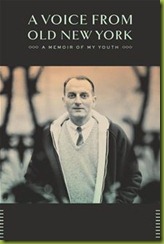
AuchinclossA Voice from Old New York is not an autobiography.It’s not exactly a memoir either, being generally low on gossip about the author or others.The chapters don’t quite flow into each other, instead each stands on its own. The book feels more like the reader is meeting Louis Auchincloss for coffee or drinks at a quiet hotel bar (upper East Side, please) and listening to him reminisce over over times.
Occasionally he repeats himself or lets drop tantalizing details without filling in the lines. At times you wish he’d dish the dirt a bit more or wonder at his rather set opinions but you can’t help admiring the clarity of his insight into the closed world he knew so intimately. There are not big revelations here. Auchincloss knew both the Bundy brothers (McGeorge and William) and the Dulles brothers (John Foster and Allen) but you’ll find nothing here you won’t find in their biographies. I did find yet another proof point for my personal theory that Nancy Mitford was born a bitter hag and got worse as she aged, not that I needed another.
If you want big statements on society (with and without a capital S), look to his novels and short stories. If you want to spend a few hours – this is a very short book at less then 210 pages – hearing the memories of the master chronicler of 20th Century New York Society.